In photography, the sunny 16 rule (also known as the sunny f/16 rule) is a method of estimating correct daylight exposures without a light meter. Apart from the obvious advantage of independence from a light meter, the sunny 16 rule can also aid in achieving correct exposure of difficult subjects. As the rule is based on incident light, rather than reflected light as with most camera light meters, very bright or very dark subjects are compensated for. The rule serves as a mnemonic for the camera settings obtained on a sunny day using the exposure value (EV) system.
The basic rule is, "On a sunny day set aperture to f/16 and shutter speed to the [reciprocal of the] ISO film speed [or ISO setting] for a subject in direct sunlight."[1]
Using the rule
The basic rule is, "On a sunny day set aperture to f/16 and shutter speed to the [reciprocal of the] ISO film speed [or ISO setting] for a subject in direct sunlight."[1]
For example:
- On a sunny day and with ISO 100 film / setting in the camera, one sets the aperture to f/16 and the shutter speed (i.e. exposure time) to 1100 or 1125[2] seconds (on some cameras 1125 second is the available setting nearest to 1100 second).
- On a sunny day with ISO 200 film / setting and aperture at f/16, set shutter speed to 1200 or 1250.
- On a sunny day with ISO 400 film / setting and aperture at f/16, set shutter speed to 1400 or 1500.
As with other light readings, shutter speed can be changed as long as the f-number is altered to compensate, e.g. 1250 second at f/11 gives equivalent exposure to 1125 second at f/16. More in general, the adjustment is done such that for each stop in aperture increase (i.e., decreasing the f-number), the exposure time has to be halved, and vice versa. This follows the more general rule derived from the mathematical relationship between aperture and exposure time—within reasonable ranges, exposure is inversely proportional to the square of the aperture ratio and proportional to exposure time; thus, to maintain a constant level of exposure, a change in aperture by a factor c requires a change in exposure time by a factor 1c2 and vice versa. A change in the aperture of 1 stop always corresponds to a factor close to the square root of 2, thus the above rule.
Alternative rule
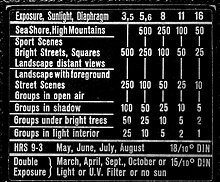
An elaborated form of the sunny 16 rule is to set shutter speed nearest to the reciprocal of the ISO film speed / setting and f-number according to this table:[3][4]
Example

This is a scene of average brightness, in direct sunlight. It was shot at ISO 100, f/8 at 1/400 second – the recommended "sunny 16" exposure – which is what autoexposure gave.
| This article uses material from the Wikipedia article Metasyntactic variable, which is released under the Creative Commons Attribution-ShareAlike 3.0 Unported License. |